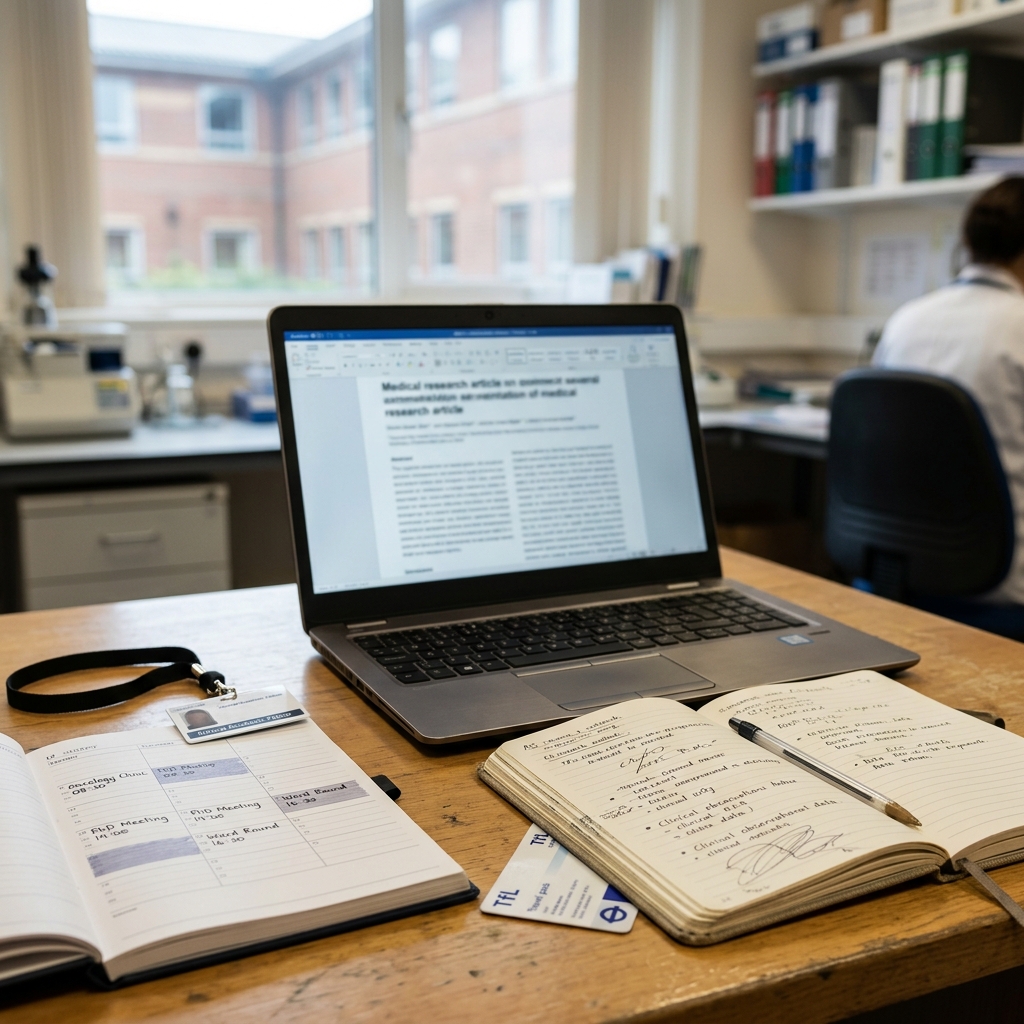
You finish a stretch of clinical work, travel back to the academic site, open your laptop and find a supervisor update, lab meeting agenda, PhD milestone plan and several admin emails waiting for you. AI looks tempting because it can turn messy notes into something more usable. But for a UK clinician-scientist in oncology, the question is not simply whether AI can save time.
The real question is where the boundary sits.
This guide is about practical boundaries for AI for clinician scientists. It is not about replacing clinical judgement. It is not about putting patient information into public AI tools. It is not about bypassing university, NHS, sponsor, funder or employer rules.
Instead, it focuses on where AI may help with non-confidential drafting, organising and summarising, and where human judgement, local policy, research governance and clinical responsibility must remain firmly in control.
Quick answer: AI may be useful for clinician-scientists when it is used on non-confidential, non-identifiable material to draft, organise or summarise academic and administrative work.
- Use it for shape: outlines, agendas, checklists, rewrite options, planning structures and first-pass wording.
- Do not use public AI tools for identifiable patient information, clinical handover content, treatment decisions, trial eligibility decisions, confidential research data or institutional sign-off.
- Treat AI output as a draft input, not as clinical, academic, governance or institutional judgement.
- Check local NHS, university, employer, sponsor and funder policies before relying on any AI-supported workflow.
If you want the shortcut version of this non-confidential workflow, the Starter AI Toolkit for Clinician-Scientists in Clinical-Academic Oncology Research (UK) packages practical prompts and planning structures for UK clinical-academic work. It is designed for drafting, organising and workflow support only, not for patient data, clinical decision-making, clinical documentation, research governance sign-off or institutional approval.
Affiliate disclosure: This article may contain an affiliate link, which means SBA Shortcut Shelf may earn a commission, at no extra cost to you. For clinician-scientists turning approved, non-confidential notes into a first-draft presentation or visual document, Gamma is one option to consider.
Why clinician-scientists need stricter AI boundaries than general productivity users
Most general productivity advice assumes the work is ordinary office work: a meeting note, a task list, a rough email, a presentation outline. Clinical-academic oncology work is different. A clinician-scientist may move between NHS-style clinical duties, consultant communication, patient handover routines, PhD milestones, laboratory discussions, sponsor expectations and small research-team workflows in the same week.
That means the risks are layered. A rough note may look administrative, but it could contain patient-identifiable information, confidential research detail, unpublished findings, sensitive colleague information or material covered by local institutional rules.
There is also a trust issue. Patients, participants, colleagues and research teams expect clinical and research information to be handled with care. Even when AI is being used only to make wording clearer, the clinician-scientist remains responsible for what is shared, what is omitted, what is checked and what is ultimately used.
Local policy variation matters too. Different NHS organisations, universities, funders, sponsors, research groups and employers may take different positions on AI use. This article is therefore educational guidance only. It is not medical, legal, data protection, governance or institutional advice. If a workflow affects patient care, research governance, official records, external communication or institutional obligations, check the relevant local rules and involve the appropriate human reviewers.
The simple rule: use AI for shape and structure, not confidential substance or judgement
A useful starting rule is this: use AI for shape and structure, not confidential substance or professional judgement.
Shape and structure means asking AI to help organise safe material into a more usable form. For example, you might ask it to turn non-confidential bullets into a supervisor update template, restructure a PhD task list into a weekly plan, create headings for a lab meeting agenda, rewrite a generic email in a clearer tone or summarise your own non-sensitive literature-reading notes.
That is different from asking AI to handle substance that belongs inside clinical, research governance or institutional judgement. Patient details, identifiable data, treatment decisions, clinical risk, trial eligibility, protocol deviations, adverse event interpretation, governance interpretation and institutional sign-off should not be handed to a public AI tool.
This distinction is not perfect, and it is not a compliance guarantee. But it gives a practical mental model for a busy clinical-academic week: let AI help with the container, the order and the wording options. Keep confidential content, patient-level facts, scientific claims, policy interpretation and final decisions with qualified humans.
Boundary map: tasks that are generally safer when no confidential information is included
The lower-risk end of AI use is usually where the input is non-confidential, non-identifiable and allowed by local policy. Even then, it is better to say generally safer rather than safe. Public AI tools should not receive material that would be inappropriate to share outside your approved systems and team processes.
For a clinician-scientist in clinical-academic oncology research, generally safer uses may include:
- Drafting a non-confidential supervisor update from generic PhD progress bullets, upcoming deadlines and questions for discussion.
- Turning personal PhD goals into a weekly plan that includes writing time, lab work, reading, admin and flexibility for unexpected clinical work.
- Creating a meeting agenda for a lab-supervisor catch-up with placeholders for progress, blockers, decisions needed and next actions.
- Rephrasing a generic email where no patient, participant, colleague-identifiable or institution-restricted information is included.
- Creating a packing or travel checklist for moving between hospital and academic sites.
- Summarising non-sensitive literature-reading notes written by you, where the notes do not include confidential project detail or unpublished sensitive results.
- Creating a first-pass structure for a presentation, progress update or research admin document, with the scientific detail added and checked by you later.
For approved, non-confidential material, Gamma is one optional way to turn checked notes into a first-draft presentation or visual document. Do not include patient information or unpublished sensitive research, and verify every scientific claim, citation, permission and institutional requirement before using the output.
The important point is that AI does not need the sensitive detail to help with the shape of the work. You can use placeholders such as project milestone, supervisor question, analysis task or deadline rather than entering information that belongs inside secure institutional systems.
Do not include patient details, unpublished sensitive data, identifiable colleague details, confidential protocols, participant information, institution-restricted material or commercially sensitive research information. If you are unsure whether something can be shared with a public AI tool, do not include it.
Use with extra review: drafts that still need expert correction and local policy checks
Some tasks sit in the middle. AI may be able to help create a first draft, simplify wording or suggest a structure, but the output still needs careful expert review before it goes anywhere.
Examples include grant progress summaries, lay summaries based only on non-confidential material, draft emails to supervisors, draft lab meeting updates, generic patient-public involvement planning notes with no real participant data, and conference abstract structures where the scientific content is written and checked by the researcher.
These uses need more caution because the wording may affect how your work is understood by supervisors, collaborators, funders, research teams or public contributors. AI can produce fluent text that still contains inaccuracies, omissions, overstatements or wording that does not match your institution, funder or team expectations.
Before using any draft, check the facts, tone, authorship implications, scientific claims, missing context and local rules. Where relevant, ask your supervisor, consultant, principal investigator, research manager, governance contact or team lead to review the material through the normal route.
Do not assume that AI-generated or AI-assisted academic text is acceptable for a journal, university, funder, NHS organisation or sponsor. Treat this as a policy-checking question, not a settled rule.
Human-only areas: what should stay outside public AI tools
Some areas should remain human-led and should stay outside public AI tools. The boundary should be especially firm where the work involves patients, clinical judgement, confidential research information, governance interpretation or official institutional decisions.
Do not enter the following into public AI tools:
- Identifiable patient information or any content that could reasonably identify a patient or participant.
- Clinical handover content.
- Oncology treatment decisions, diagnosis, triage, prescribing or patient-specific risk assessment.
- Consultant communication containing patient-specific details.
- Trial eligibility decisions or patient-specific trial discussions.
- Protocol deviations, adverse event interpretation or safety reporting judgement.
- Confidential research data, unpublished sensitive results or restricted protocols.
- Ethics, governance or sponsor determinations.
- Institutional policy interpretation or sign-off.
- Final academic claims, authorship decisions, plagiarism concerns or research integrity decisions.
AI output should not be treated as a substitute for clinical judgement, supervisor judgement, consultant review, research governance processes, sponsor requirements or local policy. If the task could affect patient care, participant safety, study conduct, official records, academic integrity or institutional accountability, keep it in the appropriate human-led process.
This does not mean AI has no place in a clinician-scientist workflow. It means the useful place is narrower and more deliberate: non-confidential support for drafting, planning, organising and summarising, with qualified human review before use.
A practical habit: pause, strip, prompt, review, decide
During a busy clinical-academic week, you need a habit that is simple enough to use when you are tired. Try this five-step check before using AI.
- Pause and classify the task. Is this admin structure, academic drafting, clinical information, confidential research material, governance interpretation or a decision? If it is clinical, confidential or decision-heavy, stop and use the appropriate human-led route.
- Strip out confidential or identifiable material. Remove patient information, participant details, identifiable colleague information, restricted protocols, unpublished sensitive findings and institution-restricted detail. Use placeholders where appropriate.
- Prompt for structure, options or wording only. Ask for an agenda, checklist, outline, neutral wording, summary structure or planning format. Avoid asking AI to decide what is correct clinically, scientifically, ethically or institutionally.
- Review for accuracy, tone, policy fit and missing context. Check every output. Look for overclaiming, invented detail, wrong emphasis, missing caveats and wording that does not fit your local setting.
- Decide as the clinician-scientist. You remain responsible for what is used. Involve supervisors, consultants, governance teams, research managers or institutional contacts where appropriate.
AI output is a draft input, not a decision. The more the output affects people, patient care, research conduct, external communication or institutional accountability, the more human review it needs.
Clinician-scientist AI boundary map
Use this boundary map as a quick pre-use check. It is deliberately cautious. Generally safer still means non-confidential, non-identifiable and allowed by local policy.
1. Generally safer non-identifiable support
- Supervisor update structures based on generic PhD progress points.
- Weekly planning from non-sensitive research and admin tasks.
- Lab meeting agendas with placeholders.
- Generic email rewording with no sensitive content.
- Travel or packing checklists for moving between clinical and academic sites.
- Summaries of your own non-sensitive reading notes.
- First-pass structures for presentations or research admin documents.
2. Use with extra review
- Grant progress summary drafts based only on shareable information.
- Lay summaries using non-confidential material.
- Supervisor or collaborator email drafts.
- Lab meeting update drafts.
- Generic patient-public involvement planning notes with no real participant data.
- Conference abstract outline structures, where the scientific content is written and checked by you.
3. Human-only areas
- Patient care, clinical handover, triage, diagnosis, prescribing and treatment planning.
- Identifiable patient or participant information.
- Patient-specific trial eligibility or risk assessment.
- Protocol deviations, adverse event interpretation and safety reporting judgement.
- Confidential research data, unpublished sensitive results and restricted protocols.
- Ethics, governance, sponsor, funder or institutional determinations.
- Final academic claims, authorship, plagiarism and research integrity decisions.
Three safer prompt examples
Supervisor update draft: Draft a concise supervisor update from these non-confidential bullet points about my PhD progress, upcoming deadlines and questions for discussion. Keep it professional, brief and suitable for a UK clinical-academic context.
Safety note: Only use generic progress points. Do not include patient information, identifiable colleague details, confidential research findings, unpublished sensitive data or institution-restricted material.
Weekly planning: Turn this non-sensitive list of research and clinical-academic admin tasks into a realistic weekly plan with priority levels, protected writing time and space for unexpected clinical work.
Safety note: Keep the task list non-confidential. Do not include ward details, patient details, rota information that should not be shared, or confidential team information.
Lab-supervisor agenda: Create a neutral meeting agenda for a lab-supervisor catch-up covering progress, blockers, decisions needed and next actions. Use headings and leave placeholders where I should add details myself.
Safety note: Ask AI for structure only. Add scientific, governance or project-specific detail yourself after checking what can be shared and what requires team approval.