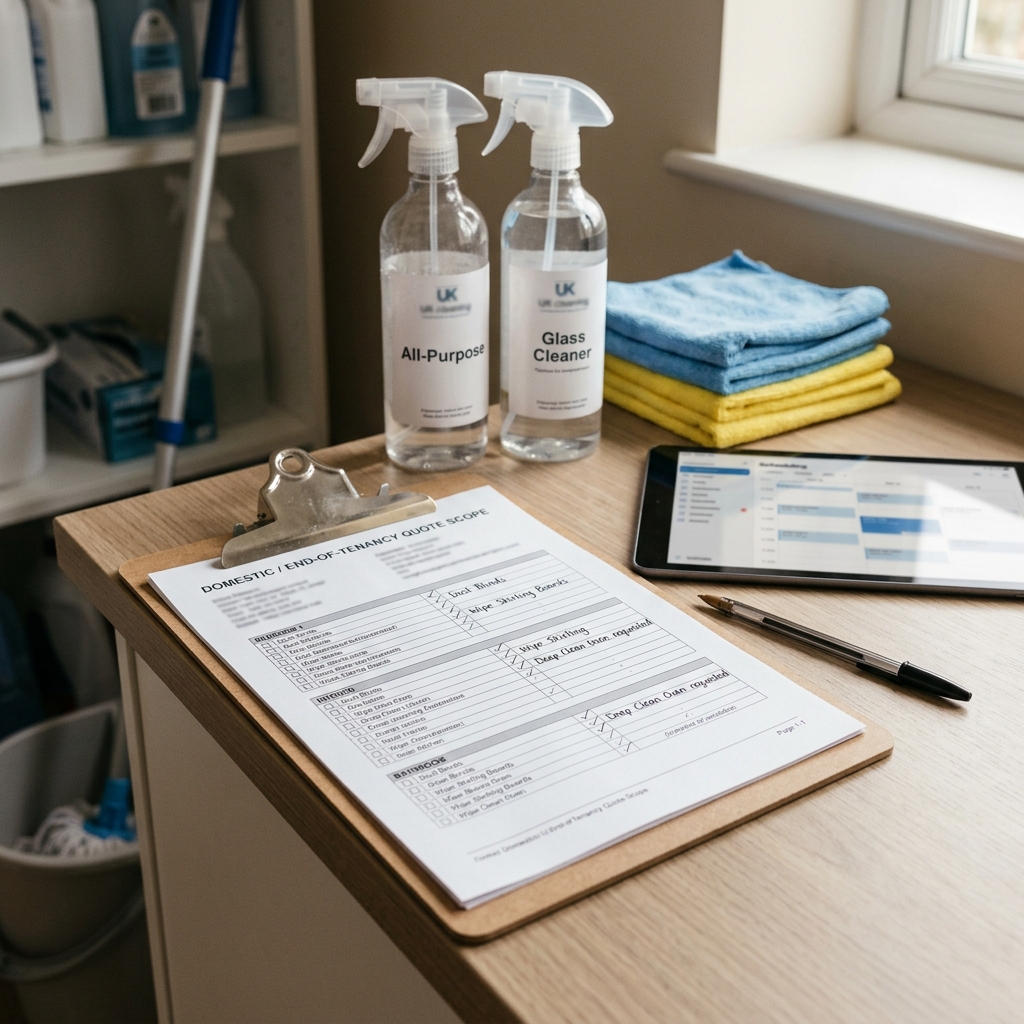
You quote an end-of-tenancy clean from a short message. The tenant says it is a two-bed flat and asks for a price as soon as possible. You reply from your phone between jobs. The cleaner arrives with basic notes. Later, the tenant says the inside windows, cupboard interiors and oven should all have been included. The landlord has also pointed out marks that may not be cleaning-related.
That sort of follow-up can feel awkward because everyone may believe they understood the job. The owner had one picture in mind. The client had another. The cleaner worked from the notes they were given. The landlord or agent may be judging against a different expectation again.
This article is not legal, tenancy, liability or complaint-resolution advice. It is a practical look at why cleaning company quote scope confusion happens and how clearer notes can help. For owners exploring AI for cleaning company owners, the useful role for AI here is simple: it can help organise your wording, spot gaps and draft clearer notes. It should not decide your price, your scope, your promises or your response to a disagreement.
Cleaning company quotes often get misunderstood because the enquiry, quote, cleaner handover and follow-up message do not all describe the same job in the same level of detail.
- Clearer scope notes help by recording what is included, what is excluded, what still needs checking and what the cleaner should pay attention to.
- Cleaner handover notes help because the cleaner sees the practical version of the job, not just a vague label such as deep clean or end-of-tenancy clean.
- AI prompts can help turn rough owner notes into clearer draft wording and missing-information checklists.
- The owner still decides price, scope, final messages, re-clean responses and any judgement calls.
If you want the shortcut version of this workflow, the Starter AI Toolkit for Domestic and End-of-Tenancy Cleaning Company Owners (UK) includes practical AI prompt and checklist support for drafting scope notes, cleaner handovers and careful client replies. It is designed to help you structure your own judgement, not replace it.
Affiliate disclosure: This article may contain an affiliate link, which means SBA Shortcut Shelf may earn a commission, at no extra cost to you. If you want a simple way to collect room details, requested extras, access notes, photos and quote information more consistently, Tally is one option to consider.
The real problem is often scope drift, not just the quote price
When a cleaning quote is misunderstood, it is tempting to assume the issue was the price. Sometimes price is part of it. But in many day-to-day cases, the bigger problem is scope drift.
Scope drift means the job gradually becomes understood as bigger, smaller or different from what the owner originally meant. Nobody has to be acting unfairly for this to happen. It can happen because a short phrase carries different meanings for different people.
For example, a client may ask for a deep clean and assume inside windows are included. The owner may have meant kitchen, bathroom and general surfaces, with windows quoted separately. The cleaner may not have been told about heavy oven build-up. A tenant may assume cupboard interiors are included in an end-of-tenancy clean. A landlord may expect marks removed from walls or fittings, even where those marks may not be cleaning-related.
The tricky part is that broad labels sound clear until someone has to do the work. End-of-tenancy clean, move-out clean, sparkle clean and deep clean can all mean different practical tasks depending on the property, condition, agreement and business process.
Clearer notes do not guarantee everyone will agree. They can, however, reduce avoidable confusion by making the working picture of the job easier for the client, cleaner and owner to share.
Where cleaning quote misunderstandings usually begin
Most quote misunderstandings do not begin with one dramatic mistake. They usually begin with small gaps that get carried through the job.
Enquiry gaps are common. A client might say it is a three-bed house, but not mention two bathrooms, a conservatory, a utility room, a heavily used oven or furnished rooms. They may not say whether carpets, inside windows, fridge interiors or cupboard interiors are expected.
Assumptions in the quote can also create trouble. The owner may know what their usual clean includes, but the client may not. A phrase such as standard end-of-tenancy clean may be clear inside your business, but vague to someone booking for the first time.
Missing exclusions are another weak point. If the quote does not say that certain tasks are not included unless agreed, the client may fill the gap with their own expectation. This can apply to carpets, exterior windows, mould treatment, heavy limescale, paint marks, appliance interiors, rubbish removal or high-level areas.
Unclear property condition makes the quote harder to judge. Photos can help, but client-supplied photos may not show the worst areas. A kitchen might look tidy from the doorway while the oven, extractor, fridge seals and cupboard interiors need far more attention. A bathroom photo may not show heavy limescale around taps or shower screens.
Access and parking details can affect the day as well. Key collection, lift access, parking restrictions, time windows, locked rooms, missing electricity or water, and agent-held keys can all change how smoothly the job runs. These details are not just admin. They affect what the cleaner can realistically do on arrival.
Rushed replies sent from a phone often make the problem worse. The owner may know the context, but the cleaner and client do not see the thoughts behind the quick message. A short reply might be efficient at the time, then expensive in back-and-forth later.
The three handover points that need the clearest notes
A cleaning job usually passes through three important handover points before anyone raises a concern. If the notes are vague at any of these points, the job can drift.
1. Client to owner
This is the enquiry stage. Before quoting or confirming, the owner needs enough detail to understand the job being requested. That may include property type, room count, bathrooms, kitchen details, appliance interiors, cupboard interiors, carpets, windows, furnished or unfurnished status, known condition issues, access, key collection and any agent or landlord expectations the client has mentioned.
2. Owner to client
This is the confirmation stage. The client should see a plain summary of the cleaning company quote scope: what is included, what is not included unless agreed, what assumptions the quote is based on and what still needs confirming. This is not about making the message long or legalistic. It is about avoiding hidden assumptions.
3. Owner to cleaner
This is the operational handover. The cleaner needs practical job instructions that match the confirmed scope. If the client confirmation says oven interior included, the cleaner handover should not simply say kitchen clean. If heavy limescale was mentioned, the cleaner should know before they arrive. If carpets are excluded, the cleaner should not be left to discover that from the client at the door.
Weak wording versus clearer wording
Weak wording: End-of-tenancy clean for two-bed flat. Please do usual clean. Tenant wants it ready for agent.
Clearer wording: Two-bed unfurnished flat, one bathroom. Include kitchen surfaces, bathroom, floors, skirting boards, internal cupboard wipe-out where accessible, and oven interior. Inside windows not included unless office confirms. Heavy limescale reported in bathroom. Keys collected from agent at 9am. If client or agent asks for extra work, check with office before agreeing.
The clearer version is still not a guarantee against disagreement. But it gives the cleaner, client and owner a more consistent picture of the job.
A scope-confusion map for cleaning jobs
Use this map as a diagnostic tool when a quote feels vague or when a job has already led to awkward follow-up. It is not a legal checklist. It is a practical way to see where confusion can enter the job.
- Property areas
Possible misunderstanding: Client says two-bed flat, but expects hallway, utility cupboard, balcony or conservatory included.
Clearer note to add: List rooms and areas included by name, and flag any areas not yet confirmed.
Who needs to see it: Client, owner and cleaner. - Task inclusions
Possible misunderstanding: Client assumes oven, fridge, inside windows or cupboard interiors are automatically included.
Clearer note to add: Name the included tasks rather than relying only on the service label.
Who needs to see it: Client and cleaner. - Task exclusions
Possible misunderstanding: Client expects carpets, exterior windows, rubbish removal or high-level areas without these being agreed.
Clearer note to add: State common items not included unless separately agreed.
Who needs to see it: Client and office team, with cleaner aware where relevant. - Condition issues
Possible misunderstanding: Heavy oven build-up, limescale, mould staining or long-term marks are not mentioned until the cleaner arrives.
Clearer note to add: Record known condition issues and anything that needs checking before confirming expectations.
Who needs to see it: Owner and cleaner, with client confirmation where appropriate. - Time limits or access windows
Possible misunderstanding: Cleaner has limited time because of key return, checkout appointment or building access hours.
Clearer note to add: Note start time, access deadline, key return time and any priority order if time becomes tight.
Who needs to see it: Cleaner and office. - Keys and access
Possible misunderstanding: Keys are with an agent, code is missing, parking is restricted or a room is locked.
Clearer note to add: Record key collection, access contact, parking notes and what to do if access fails.
Who needs to see it: Cleaner and owner. - Supplies or equipment assumptions
Possible misunderstanding: Client assumes specialist equipment, carpet cleaning machine or certain products will be brought.
Clearer note to add: Confirm what the business is providing and what is not part of this booking.
Who needs to see it: Client, owner and cleaner. - Photos and evidence
Possible misunderstanding: Photos show tidy rooms but not problem areas such as oven trays, shower screen, fridge seals or behind furniture.
Clearer note to add: Ask for photos of specific areas where condition affects the job, while noting that photos may not show everything.
Who needs to see it: Owner before confirming, cleaner where helpful. - Cleaner priorities
Possible misunderstanding: Cleaner spends time on general areas while client mainly cares about oven, bathroom limescale or agent-visible details.
Clearer note to add: List priority areas and any items to check with the office before doing extra work.
Who needs to see it: Cleaner. - Re-clean or follow-up communication
Possible misunderstanding: A follow-up message refers to tasks that may not have been included or condition issues that were not confirmed.
Clearer note to add: Keep a neutral record of the agreed scope, photos received, cleaner notes and details still needed from the client.
Who needs to see it: Owner, and client where a careful reply is needed.
How AI can help with clearer scope notes without taking over the decision
Used carefully, AI can be helpful for busy cleaning company owners because it is good at turning rough notes into clearer wording. It can help you organise a messy enquiry, create a missing-information checklist, draft end-of-tenancy cleaning scope notes, prepare cleaner handover notes and make a re-clean reply sound calmer.
The key is to keep AI in the right role. It should be your drafting assistant, not your manager, solicitor, pricing tool or complaint handler.
AI can help with:
- rewriting rough notes into a clearer scope summary;
- separating included tasks, exclusions, assumptions and questions;
- turning a confirmed scope into cleaner handover notes;
- spotting details you have not yet confirmed;
- drafting neutral wording for owner review.
AI should not:
- set the final price;
- decide whether something is included;
- make promises to the client;
- resolve a dispute or decide responsibility;
- accept liability;
- interpret tenancy agreements;
- replace your judgement about the actual job.
Be careful with personal and access information. If you use a public AI tool, avoid pasting full names, exact addresses, phone numbers, access codes, key safe details or sensitive customer information unless you have a suitable process for doing so. Use placeholders where possible, then add the real details back in your own system after you have reviewed the draft.
Prompt examples for safer drafting
Quote scope prompt: Turn these rough notes into a clear cleaning quote scope summary for a UK domestic cleaning client. Keep the wording polite and plain. Separate included tasks, not included unless agreed, details still to confirm, and access notes. Do not add new promises or prices. Here are my notes: [paste anonymised notes].
Safety note: Check that every included and excluded item is accurate before sending. AI must not invent tasks, prices, timings or guarantees.
Cleaner handover prompt: Create a cleaner handover note from this confirmed job scope. Make it practical for the cleaner on the day. Include address/access notes, priority areas, known condition issues, items not included, and questions to ask the office before doing extra work. Use only the information I provide: [paste confirmed scope with placeholders where needed].
Safety note: The handover must match the confirmed client scope. Remove any instruction that could create safety, liability, chemical-use or property-damage issues.
Re-clean reply prompt: Review this draft reply to a re-clean request and make it calmer and clearer. Do not admit fault, reject the request, make legal claims, or promise a solution. Help me ask for the missing details and refer back to the agreed scope in neutral language. Draft reply: [paste anonymised draft].
Safety note: Any re-clean or complaint reply should be owner-reviewed. AI should help with tone and structure only, not decide responsibility, entitlement or outcome.
Make clearer scope notes part of the everyday quoting habit
You do not need to rebuild your whole admin process at once. Start with one job type where misunderstandings are most awkward or time-consuming. For many domestic and end-of-tenancy cleaning companies, that might be end-of-tenancy cleans because several people can have different expectations: tenant, landlord, agent, cleaner and owner.
Create one reusable scope-note template for that job type. Keep it short enough to use on a busy day, but specific enough to cover rooms, key tasks, exclusions, condition issues, access, photos and cleaner priorities.
Then use it in two places: the client confirmation and the cleaner handover. The wording does not have to be identical, but the meaning should match. If the client sees oven included, the cleaner should see oven included. If carpets are excluded unless agreed, the cleaner should not be left to handle that conversation at the property.
Some owners also find it useful to turn the checklist into a simple intake form for quote requests or re-clean details. If you want a low-friction form option, Tally can be used to collect rooms, extras, access notes, photos and follow-up details more consistently. A form will not solve scope disagreements by itself, but it can help you collect better information before you draft the reply or handover.
The habit to build is simple: before you send a quote, ask whether the client, cleaner and owner would all picture the same job from the notes. If not, the notes need one more pass.
AI-assisted scope-note checklist for cleaning company owners
Use this checklist before confirming a quote, preparing cleaner handover notes or replying to a scope-related follow-up. AI can help format the notes and flag gaps, but the owner decides the final scope and wording.
- What exact job type is being quoted?
For example: regular domestic clean, one-off deep clean, pre-sale clean, move-in clean or end-of-tenancy clean. Avoid relying on the label alone. - Which rooms, areas and items are included?
List bedrooms, bathrooms, kitchen, hallway, utility, conservatory, appliance interiors, inside windows, cupboards and any other agreed areas. - Which common assumptions are not included unless agreed?
Record items such as carpets, exterior windows, rubbish removal, specialist treatments, high-level areas or other extras according to your own business process. - What condition issues have been mentioned or shown?
Note heavy oven build-up, limescale, staining, furnished rooms, pet hair, fridge condition, mould staining or areas where photos are unclear. - What access, timing or key details affect the job?
Include key collection, parking, lift access, entry codes kept outside AI prompts where possible, checkout times, locked rooms and key return. - What should the cleaner prioritise?
Identify the areas most likely to matter on the day, such as oven, bathroom limescale, kitchen cupboards, agent-visible areas or floors. - What details are still missing?
Ask for missing room counts, photos of problem areas, appliance details, furnished status or access instructions before confirming where needed. - What wording should be copied into the client confirmation and cleaner handover?
Make sure the client-facing scope and cleaner-facing notes describe the same job. - What should the owner check before sending?
Check accuracy, price, scope, exclusions, tone, promises, personal data and anything that could affect responsibility, safety or property risk.
Simple AI instruction: Ask AI to organise your notes into these headings and show any missing details. Do not ask it to decide what is included, what to charge or how a disagreement should be resolved.