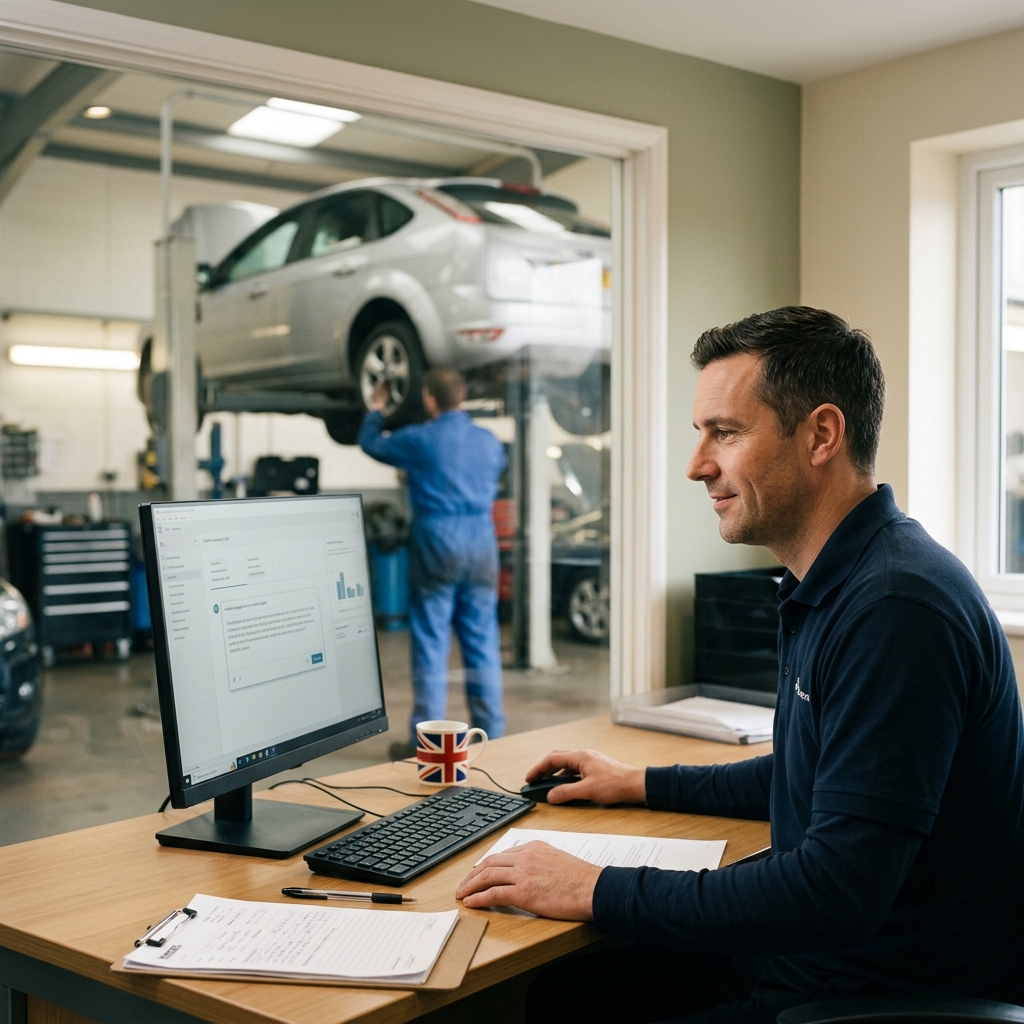
A technician has left brief notes on the job card. The phone is ringing. A customer wants to know what is happening with their vehicle. You need to explain the update clearly, without making a promise the workshop has not confirmed.
That is exactly the sort of front-desk moment where AI can be useful. Not because it knows more than the technician. Not because it can decide what is wrong with the vehicle. But because it can help turn confirmed garage facts into a clear draft message while you deal with the rest of the service desk.
For UK independent garages, the safest way to think about an AI toolkit for independent garage service advisors is simple: use AI for wording, structure and reminders. Keep diagnosis, MOT outcomes, vehicle safety, pricing, timing and final customer promises with the garage team.
This article is practical communication guidance for service advisors. It is not legal, MOT, warranty, safety or technical advice. Anything customer-facing should be checked by the right person in the garage before it is sent.
Quick answer: AI can help a garage front desk turn supplied workshop facts into clearer draft messages, organise quote follow-ups, suggest polite wording for booking changes and summarise internal notes. It should not decide what is wrong with a vehicle, whether it is safe, whether it passes an MOT, what the final price is, what legal position applies or exactly when a vehicle will be ready.
- Use AI to draft from confirmed job card, technician or service desk information.
- Tell AI not to invent missing parts, prices, timings, test results or findings.
- Review every customer-facing draft before sending.
- Keep technical, safety, MOT, price and final timing decisions human-led.
Want the shortcut version for your service desk? If you want ready-made prompts and checklists for customer updates, quote follow-ups and booking messages, the Starter AI Toolkit for Service Advisors in Independent Garages (UK) packages the beginner-friendly version of this workflow. It is designed as drafting support for confirmed garage facts, not as a replacement for technician judgement, MOT decisions, safety decisions, pricing approval or human review.
Affiliate disclosure: This article may contain an affiliate link, which means SBA Shortcut Shelf may earn a commission, at no extra cost to you. For garage service desks that need a more structured way to route customer calls and manage call follow-up, CallHippo is one option to consider.
The simple rule: AI drafts, the garage decides
The easiest boundary is this: AI may help write the message, but it should not decide what the message promises.
Drafting help means asking AI to improve the wording of information you already have. For example, you might paste a short, anonymised technician note into a prompt and ask for a plain customer update. The facts still come from the job card, technician, MOT tester, service advisor or garage owner.
Decision-making is different. AI should not decide whether a part is required, whether a vehicle is safe to drive, whether an MOT has passed or failed, what the final invoice should be, whether a warranty or refund position applies, or what time the customer can definitely collect the vehicle.
A useful test is to ask: if the customer acted on this message, who would the garage expect to stand behind it? If the answer is the technician, MOT tester, service advisor or owner, then that person needs to confirm the final wording before it goes out.
Safe front-desk tasks where AI can be useful
AI is most useful on the service desk when the garage already knows the facts and the task is mainly about clarity, tone or organisation. It can help you get from rough notes to a customer-ready draft more quickly, as long as you still check it.
Useful front-desk tasks include:
- Customer update drafts: turning confirmed inspection notes into a clear message about what has been checked, what is waiting for approval, or what the next step is.
- Quote follow-up wording: drafting a polite message after the garage has already approved the quote, scope, price and any timing language.
- Booking change messages: explaining a confirmed booking change because parts, workshop capacity or agreed timing has changed.
- Workshop notes to customer wording: translating short technician notes into plain English without adding diagnosis, safety advice or new recommendations.
- Call notes: helping turn a call into a tidy internal summary for the job record, using only what was actually discussed.
- Complaint acknowledgements: drafting a calm acknowledgement that confirms the garage has received the concern, without admitting fault, promising an outcome or giving legal conclusions.
- Internal reminders: creating a list of follow-up tasks such as call customer, check parts ETA, confirm authorisation or update job card.
For phone-led garage teams, CallHippo is one optional cloud phone system for routing customer calls and keeping call activity more visible across the service desk. It does not supply job facts, diagnose faults or replace the garage’s normal checks; any recording, SMS or other communication features should only be used after checking regional availability, consent, privacy and data-handling requirements.
The important phrase is using confirmed facts. AI should not be treated as a source of garage information. It is a drafting assistant, not a technician, parts advisor, MOT tester, pricing approver or garage owner.
Tasks AI should not handle for a garage
Some garage topics are too important for AI to decide. This does not mean AI is useless. It means the boundary needs to be clear, especially when the message affects safety, money, official test outcomes or customer expectations.
AI should not determine or approve:
- vehicle diagnosis or fault cause;
- whether a repair is necessary;
- MOT outcome or MOT wording;
- vehicle roadworthiness or safety;
- whether a customer should drive the vehicle;
- legal rights, refund position or warranty position;
- final quote approval, invoice amount, VAT wording, parts or labour charges;
- final collection timing or guaranteed completion time;
- customer authorisation wording where the garage has not already approved it.
It should also not invent missing information. If the technician note does not include a part name, price, labour time, test result, collection time or confirmed finding, the AI draft should leave that point out or flag it for human checking.
On a busy front desk, the risk is not usually that someone asks AI to run the workshop. The risk is that a draft sounds more certain than the garage intended. Watch for phrases that turn an estimate into a promise, a note into a diagnosis, or a draft into an approved customer position.
A garage front-desk AI boundary map
A boundary map helps service advisors decide what AI can safely help with and what must stay with the garage. You can use it before asking for a draft, or as a quick check before sending the message.
1. Customer update after inspection
- AI can help draft: a clear update using [vehicle], [confirmed technician note] and [next step].
- Human-led decision: technical accuracy, repair recommendation, safety wording, MOT wording and whether anything needs customer authorisation.
- Review question: does this message only say what the job card or technician has confirmed?
2. Quote follow-up
- AI can help draft: a polite follow-up using [quoted amount], [approved work summary] and [customer contact option].
- Human-led decision: final price, parts, labour, VAT wording if used, timing and authorisation process.
- Review question: has AI changed anything from the approved quote?
3. Booking change because parts or workshop time changed
- AI can help draft: an apologetic message using [original booking], [new proposed option] and [confirmed reason].
- Human-led decision: parts availability, workshop capacity, collection estimate and whether the proposed option is actually available.
- Review question: are we promising a time the workshop has not confirmed?
4. Workshop notes translated into plain customer wording
- AI can help draft: plainer wording from [technician note] and [approved wording].
- Human-led decision: diagnosis, repair need, safety implication, MOT implication and any customer instruction.
- Review question: has the draft added meaning that was not in the technician note?
How to prompt AI without giving it too much control
Good prompts for garage service advisors are not about sounding clever. They are about giving AI a narrow job. Tell it what facts it can use, what it must not add and what you will review afterwards.
Use placeholders rather than unnecessary personal data, especially if you are using a public AI tool. For example, use [customer], [vehicle], [registration if needed internally], [job card note] or [approved quote summary] rather than pasting more customer information than the draft requires.
Prompt example: customer update from workshop notes
Turn these confirmed workshop notes into a clear customer update. Use only the facts below. Do not add a diagnosis, safety advice, MOT outcome, price or collection time unless it is included. Keep the tone polite and plain. Facts: [paste confirmed technician notes]. Customer context: [brief context]. Points to avoid: [anything not yet confirmed].
Safety note: check the draft against the job card and technician notes before sending. AI must not fill in missing technical, safety, MOT, timing or price details.
Prompt example: quote follow-up
Draft a polite quote follow-up message for a customer who has been given this approved quote: [approved quote summary]. The aim is to check whether they would like to go ahead or ask questions. Do not pressure the customer. Do not change the price, parts, labour or timing. Include a reminder that they can contact the garage if they want to discuss it.
Safety note: only use a quote that has already been checked by the garage. The AI draft must not alter the quoted amount, scope of work, authorisation wording or any approved terms.
Prompt example: booking change
Draft a booking change message using these confirmed details: Original booking: [date/time]. New proposed option: [date/time]. Reason we can share with the customer: [confirmed reason]. Keep it apologetic and practical. Do not guarantee completion time unless stated here: [confirmed timing].
Safety note: a human must confirm the new booking option, parts or workshop availability and any collection-time wording before the message is sent.
A useful extra instruction is: If any point is unclear or missing, do not guess. Add a short list of points for the service advisor to check. That keeps the AI in a support role and makes the review easier.
Human review checklist before sending anything
Before any AI-written message goes to a customer, use a short front-desk review. This is internal quality control, not legal or technical advice. The aim is to catch overconfident wording and make sure the garage can stand behind what it sends.
- Facts: are all facts from the job card, technician, MOT tester, approved quote or garage system, not invented by AI?
- Technical point: has the technician or authorised person confirmed any technical explanation?
- Price: are price, VAT wording if used, labour and parts details approved internally?
- Timing: is the timing phrased as an estimate unless the garage has confirmed it as definite?
- MOT, safety and driving: does the message avoid MOT, safety, roadworthiness or whether to drive conclusions unless the garage has confirmed the wording?
- Warranty, refund or complaint wording: does the message avoid legal, warranty or refund conclusions unless the garage has approved the position?
- Authorisation: is it clear what the customer is being asked to approve, if anything?
- Tone: is the message calm, plain and respectful?
- Accountability: would the garage be comfortable standing behind the message if the customer referred back to it?
If the answer to any of these is no, pause the message. Check the job card, ask the technician, speak to the owner or rewrite the draft before sending.
AI boundary map for the garage front desk
Use this as a quick service desk map when deciding whether AI is suitable for a task. The safe pattern is always the same: AI drafts the wording, the garage owns the facts and decisions.
Customer update after inspection
- Front-desk task: update the customer after [vehicle] has been inspected.
- What AI can safely help draft: a clear message from [confirmed technician note], [current status] and [next step].
- What must stay human-led: diagnosis, repair recommendation, safety wording, MOT wording, price and authorisation.
- Review before sending: has the technician or authorised person confirmed every technical point?
Quote follow-up
- Front-desk task: follow up an approved quote with the customer.
- What AI can safely help draft: polite wording that asks whether the customer would like to go ahead or discuss [approved quote summary].
- What must stay human-led: [quoted amount], parts, labour, VAT wording if used, timing and authorisation wording.
- Review before sending: has AI kept exactly to the approved quote and avoided pressure?
Booking change
- Front-desk task: explain a booking change because [confirmed reason] affects parts, workshop time or agreed scheduling.
- What AI can safely help draft: an apologetic and practical message with [original booking] and [new proposed option].
- What must stay human-led: availability, parts status, workshop capacity and any collection-time wording.
- Review before sending: is the new option genuinely available and is any timing phrased correctly?
Workshop notes into plain customer wording
- Front-desk task: turn [technician note] into wording a customer can understand.
- What AI can safely help draft: a plain English version that uses only [approved wording] and confirmed facts.
- What must stay human-led: technical meaning, diagnosis, repair need, safety implication, MOT implication and customer instruction.
- Review before sending: has the draft changed the meaning of the technician note or added anything new?