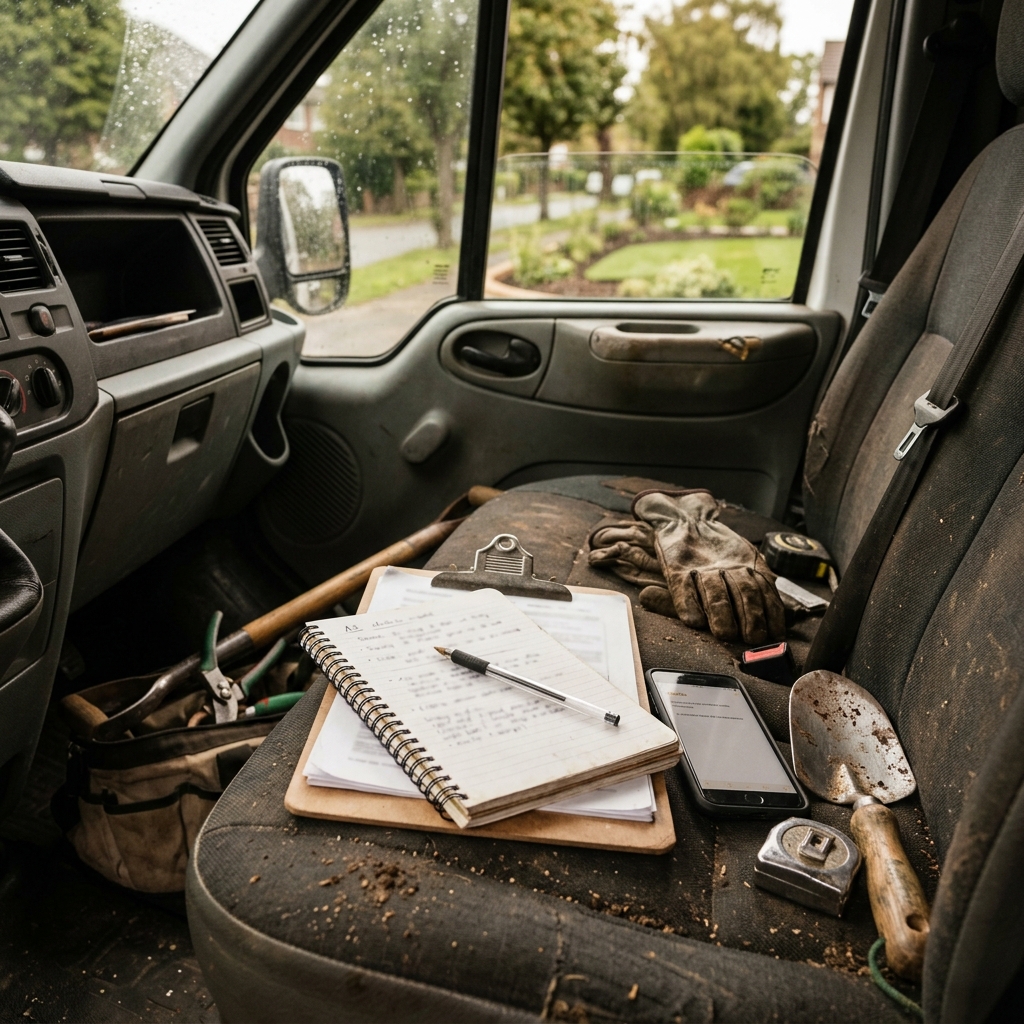
You get back to the van after the third garden visit of the day. One customer wants regular lawn and border maintenance. Another wants a hedge reduced, green waste removed and a tired planting area refreshed. The last one mentioned access through a side gate, a dog that needs keeping indoors and a possible date before a family event.
You know what you saw. The problem is not lack of skill. It is turning rough notes from your phone, notebook, photos and memory into a clear follow-up when you still have messages to answer, tools to sort and tomorrow’s work to think about.
Used carefully, AI can help with that admin gap. For a small UK landscape gardening or garden maintenance business, an AI toolkit for landscaping business owners should not replace your judgement. It should help you organise notes, spot missing details and draft a clearer customer message before you prepare the quote properly.
This workflow keeps the useful part of AI in its lane: sorting, summarising and drafting. You still decide what is included, what is excluded, what it costs, when it can happen and what advice you are prepared to stand behind.
Quick answer: AI can help landscape gardening business owners turn rough garden visit notes into clearer quote follow-ups by organising notes into confirmed facts, missing information, customer priorities, practical constraints and possible next steps.
- Use AI to tidy and structure your notes.
- Ask it to flag gaps before you price or promise anything.
- Make your owner decisions separately, especially around scope, price, timing, materials, waste and plant or lawn advice.
- Use AI to draft the customer follow-up, then check every detail before sending.
If you want the shortcut version
If you want the ready-to-use prompts and checklist packaged for this role, the Starter AI Toolkit for Independent UK Landscape Gardening and Garden Maintenance Business Owners gives you practical AI prompts for garden visit notes, customer follow-ups and day-to-day admin. For owners who want deeper repeatable workflows, the Advanced Toolkit and Bundle options are also available.
Affiliate disclosure: This article may contain an affiliate link, which means SBA Shortcut Shelf may earn a commission, at no extra cost to you. For UK landscape gardening and garden maintenance business owners who want a dedicated place to manage enquiries, quotes, scheduling, job notes and invoices after organising their garden visit notes, Tradify is one option to consider.
Why garden visit notes often become unclear follow-ups
Garden visit notes rarely start life as neat admin. They are usually a mix of quick phone notes, notebook scribbles, photos, customer comments and things you are trying to remember until later.
That is normal. On a busy day you might look at a small lawn maintenance enquiry in the morning, a border clearance after lunch and a larger landscaping visit on the way home. By the time you sit down to write follow-ups, the details can start to blur.
The tricky part is that garden work often includes practical conditions that matter to the quote. Access may only be through a narrow gate. Parking may be difficult. There may be green waste to remove, materials to supply, pets to consider, or a customer preference about visit days.
Recurring maintenance and one-off project work also need different handling. A regular maintenance customer may need a note about visit frequency, seasonal tasks and what will be reviewed over time. A one-off landscaping job may need clearer scope boundaries before you can price it sensibly.
Weather and season add another layer. Hedge work, lawn care, planting, clearance and ground preparation can all be affected by conditions and timing. The risk is that you either delay contact because the notes feel messy, or you send a vague follow-up that leaves the customer unsure what happens next.
What AI should and should not do in this workflow
The safest way to use AI for landscape gardening admin is to treat it as an organiser and drafting assistant, not as a pricing engine, site surveyor or horticultural adviser.
It can help you turn scattered notes into something clearer. It can also help you phrase a polite message. But it should not decide the commercial or practical commitments that sit with you as the business owner.
Safe AI tasks
- Organising rough garden visit notes into useful headings.
- Summarising what the customer appears to care about most.
- Creating a list of missing or unclear information.
- Drafting a polite follow-up message for you to edit.
- Adjusting tone so the message sounds clearer, warmer or more concise.
- Checking a draft for vague promises or assumptions.
Owner-only decisions
- Pricing, labour assumptions and margins.
- Materials, plants, products and equipment choices.
- Waste handling and removal arrangements.
- Access constraints and whether they affect the job.
- Timing, visit frequency and weather-dependent scheduling.
- Plant, hedge, lawn or soil treatment recommendations.
- Scope exclusions, caveats and what is not included.
- Final approval of anything sent to the customer.
This boundary matters because AI can produce confident wording even when the underlying detail is missing. If a note says small hedge tidy, AI does not know the height, access, waste volume, safety considerations or the customer’s exact expectation. You do.
The garden visit notes to quote follow-up checklist
Before asking AI to write anything customer-facing, it helps to separate what you know from what still needs checking. This reduces the chance of the follow-up sounding more certain than it should.
The checklist below is deliberately practical rather than formal. It is not a professional survey template. It is an admin aid for getting your notes into a better shape before you quote.
Use these categories before drafting
- Customer and job basics: name or reference, broad location, enquiry type and whether this is a new or existing customer.
- Confirmed site facts: what you actually saw, measured, photographed or discussed.
- Customer priorities and concerns: for example privacy, low maintenance planting, tidier borders, safer access or regular lawn care.
- Photos or measurements to check: anything you need to compare against your phone photos, sketches or measurements.
- Access, parking, pets, gates or timing constraints: practical details that may affect how the work is planned.
- Waste, materials or equipment considerations: green waste, soil, mulch, timber, plants, machinery or specialist tools to consider.
- Recurring maintenance or one-off quote context: whether the follow-up is about an ongoing visit plan or a defined project.
- Weather or seasonal dependencies: anything that should be checked before giving timing expectations.
- Missing information: questions to answer before pricing or confirming next steps.
- Owner judgement needed: decisions only you should make.
- Follow-up message instructions for AI: what the draft should and should not say.
A simple AI workflow after each garden visit
You do not need a complicated system to start using AI for garden visit quote follow-ups. The useful habit is to capture your raw notes, clean them up enough to be safe to use, then ask AI to organise rather than decide.
- Capture raw notes while details are fresh. After the visit, add quick notes on the work discussed, visible site facts, customer priorities, access, waste, timing and anything you need to check against photos.
- Remove unnecessary personal data before using AI. Avoid pasting information the tool does not need. Use initials, a job reference or a broad location where that is enough for your own process.
- Ask AI to organise the notes into checklist categories. Keep the instruction narrow and specific.
- Ask AI to flag missing or unclear information. This is often more useful than asking it to write the message straight away.
- Make owner decisions separately. Decide scope, exclusions, materials, access assumptions, waste arrangements, timing and price outside the AI tool.
- Ask AI to draft the follow-up message. Tell it not to invent prices, dates, measurements, materials or promises.
- Review before sending. Check the message against your memory, photos, measurements and business judgement.
Example scenario
Imagine a customer has asked about regular garden maintenance after an initial tidy. Your rough note says: front lawn cut, rear border overgrown, customer wants low-maintenance look, access through side gate, dog on site, green waste likely, prefers Fridays, asked about planting in spring.
AI can organise that into customer priorities, recurring maintenance points, access constraints, waste considerations and missing questions. It should not decide the visit price, recommend specific planting, promise Friday availability or confirm how waste will be handled unless you have decided those details.
Prompt you can use
I run a landscape gardening and garden maintenance business in the UK. Please organise these rough garden visit notes into: confirmed facts, customer priorities, access or timing issues, missing information, recurring maintenance points, and items I need to decide before quoting. Do not create a price, promise a date or add horticultural advice. Notes: [paste notes].
Before pasting notes into any AI tool, remove unnecessary personal details and check the organised output against your own memory, photos and measurements.
Follow-up drafting prompt
Using the organised notes below, draft a polite follow-up message to the customer. The message should thank them for the visit, confirm the main points discussed, say that I am checking the remaining details before quoting, and ask for any missing information listed. Do not invent prices, dates, materials, measurements or promises. Notes: [paste organised notes].
Treat the result as a draft only. Edit anything that affects scope, exclusions, timing, customer expectations or commercial commitments.
Follow-up message examples AI can help draft
Once your notes are organised, AI can help create different types of landscaping customer messages. These should be treated as draft types, not final customer-ready copy.
Thanks for the visit and quote to follow
Thanks for showing me the garden today. I have noted the main areas we discussed, including the lawn, rear borders and green waste. I am going to check the remaining details before preparing the quote and will come back to you with the next step.
Request for missing information
Before I prepare the quote, could you confirm whether you would like the green waste removed from site or left for your own disposal? I also want to check whether access through the side gate is available on the day of the work.
Recurring maintenance next steps
For the regular maintenance option, I have noted your preference for keeping the lawn, borders and general tidy-up on a recurring schedule. I will review the visit frequency and seasonal tasks before confirming what I can offer.
Weather-dependent scheduling caveat
Some of the timing may depend on weather and ground conditions, so I will avoid confirming a firm date until I have checked the diary and the work involved.
Scope clarification before pricing
To make sure I quote for the right work, could you confirm whether the hedge work is for a light tidy only or whether you are looking for a more substantial reduction?
Polite decline or not-a-fit message
Thank you for asking me to look at the work. Having reviewed the details, I do not think this is the right fit for the type of work I can take on at the moment, so I will step back rather than quote for something I cannot support properly.
Always check these drafts before sending. AI may make a message sound tidy while still leaving an assumption, promise or missing detail in place.
Where this fits with your wider quoting and job admin
This workflow does not need to replace your existing quote process. It sits before it.
Think of AI as the tidy-up stage between the garden visit and your normal admin. Once the notes are organised, you can move the confirmed details into your quote system, email, diary, spreadsheet, job management app or whatever process already works for your business.
For example, AI might help you turn rough notes into a clear summary of the work discussed, questions still outstanding and points to check before pricing. You would then use your own process to prepare the actual quote, confirm the scope and manage the job.
This can be especially useful if you handle both recurring maintenance rounds and one-off landscaping enquiries. The same note-organising habit can help you keep customer preferences, seasonal tasks, access details and follow-up questions from getting lost between visits.
If you want a dedicated place to manage trade admin after your AI-organised notes are ready, Tradify is one optional job management tool that may suit some small trade businesses managing enquiries, quotes, scheduling, job notes and invoices. It is not required for this AI workflow, and you can still use your existing email, diary, spreadsheet or quote process.
Garden Visit Notes to Quote Follow-Up Checklist
Copy this checklist into your notes app, quote admin document or AI prompt. Use it to separate confirmed facts from missing details and owner-only decisions before sending a customer follow-up.
1. Customer and job basics
- Customer initials or job reference.
- Broad area or town if useful.
- New enquiry, existing customer or repeat visit.
- One-off landscaping work or recurring garden maintenance.
2. Confirmed site facts
- Areas seen: lawn, borders, hedges, patio, beds, access route or other relevant spaces.
- Measurements or photos taken.
- Visible condition notes, without adding diagnosis or advice you have not checked.
3. Customer priorities and concerns
- Main result the customer wants.
- Preferences such as low maintenance, tidier appearance, privacy, pet awareness or regular upkeep.
- Any concern the customer raised that needs a careful response.
4. Access and practical constraints
- Parking, gates, narrow side access or steps.
- Pets, shared access, locked areas or preferred visit times.
- Anything that may affect how the work is planned.
5. Waste, materials and equipment considerations
- Green waste likely.
- Materials or plants mentioned but not yet decided.
- Equipment you may need to consider before quoting.
6. Recurring maintenance context
- Possible visit frequency discussed.
- Seasonal tasks such as mowing, border care, hedge tidying or leaf clearance.
- Customer preferences to remember for future visits.
7. Weather or seasonal considerations
- Work that may depend on conditions.
- Timing expectations the customer mentioned.
- Anything you should avoid promising until checked.
8. Missing information
- Questions to ask the customer.
- Measurements, photos or diary details to check.
- Anything unclear in your notes.
9. Owner judgement needed
- Price and labour allowance.
- Final scope and exclusions.
- Materials, waste arrangements and timing.
- Plant, lawn or horticultural recommendations.
- Final customer wording and commitments.
10. AI drafting instructions
- Ask AI to organise and draft, not decide.
- Tell it not to invent prices, dates, materials, measurements or promises.
- Ask it to flag unclear commitments before you send.
Optional checking prompt
Review this draft customer follow-up and flag anything that sounds like an unclear promise, an assumption, a missing detail or a commitment I may need to confirm before sending. Do not rewrite the quote itself or make pricing decisions. Draft: [paste draft].
Use this as a checking aid only. AI may miss errors or flag things that are not a problem, so your judgement remains final.