Knowing that AI could help at work is not the same as knowing what to type when a customer needs an update, rough notes need turning into actions, a handover must be prepared or a recurring process needs improving.
That gap—between recognising the potential of AI and knowing how to apply it to a real working day—is exactly why SBA Shortcut Shelf exists.
SBA Shortcut Shelf, by Systems by Adam, creates practical AI Toolkits for defined job roles, industries, subsectors and regional markets. Rather than placing hundreds or thousands of unrelated prompts into one universal PDF, each toolkit starts with a more focused question: what does this person actually need help doing at work?
The growing catalogue now covers more than 50 job roles, from administrators and coordinators to managers, specialists, business owners and self-employed professionals. Each toolkit is designed to help a busy, non-technical user move from “AI might be useful” to “I understand what to ask, what context to provide and what I still need to review myself”.
This does not mean every large prompt collection is poor, or that every buyer needs a role-specific product. Generic packs can offer breadth and inspiration. The more useful comparison is whether you want the largest possible prompt library—or a smaller, structured resource designed to begin closer to the work you actually do.
Quick answer: generic prompt packs are often useful for broad exploration. SBA Shortcut Shelf takes a different, role-first approach: its Toolkits are purpose-built around recognisable workplace tasks, relevant terminology, practical outputs and responsible human review.
- Choose a broad prompt pack when you want an idea library covering many unrelated topics.
- Choose a role-specific toolkit when you want a clearer starting point for recurring tasks in your own role.
- Consider SBA Shortcut Shelf when you know AI could help at work but want practical guidance on what to ask, how to adapt it and what to check before using the result.
The difference is not simply prompt quantity. It is the amount of translation work left for the person using the resource.
Find an AI Toolkit built around your work. Browse the growing SBA Shortcut Shelf catalogue of role-specific Starter, Advanced and Bundle options, designed to help practical workplace users know what to ask AI, how to adapt the output and what to check before using it. Browse Toolkits.
Can’t find your role? Request a Toolkit.
Why SBA Shortcut Shelf does not compete on prompt count alone
A headline such as “1,000 AI prompts” is easy to understand. It suggests choice, range and value. For someone who wants to experiment across writing, planning, marketing, research and general productivity, that breadth can be useful.
But a large number does not automatically answer the practical questions that arise during a busy working day:
- Which prompt is relevant to this task?
- What background information should be included?
- What should the finished output look like?
- How should it be adapted for this customer, colleague or workplace?
- What needs checking before it is shared or acted upon?
SBA Shortcut Shelf was created around the view that workplace usefulness depends on more than owning a long list of commands. A prompt becomes more useful when it reflects the user’s responsibilities, audience, terminology, constraints and expected output.
That is why the products are designed as practical Toolkits rather than prompt dumps. The aim is not to claim that 25 relevant prompts will always beat 1,000 general ones. It is to reduce the distance between opening a resource and finding something that resembles the task already waiting on your desk.
A generic pack may ask you to “write a professional email”. A role-specific resource can begin closer to the situation: prepare a calm repair-delay update, turn case notes into a structured handover, draft a supplier follow-up with clear next steps, or reorganise meeting notes into decisions, owners and deadlines.
The user still supplies the facts and applies judgement. The value comes from starting with a more recognisable working context.
What “role-specific” means at SBA Shortcut Shelf
At SBA Shortcut Shelf, role-specific does not mean that every purchase is individually commissioned or rewritten for one customer. The Toolkits are reusable digital products, purpose-built for a defined audience.
That audience may be shaped by several layers of context:
- Job role: the responsibilities, recurring tasks and outputs associated with the work.
- Industry and subsector: the setting in which the role operates and the situations the user is likely to recognise.
- Seniority and working style: whether the user is coordinating tasks, handling cases, managing a team, advising clients or running a business.
- Country or market: relevant spelling, terminology and workplace phrasing, without claiming legal or regulatory compliance.
- AI experience: clear guidance for people who may be new to AI or still building confidence.
These distinctions matter because the same job title can look different in different environments. A service adviser in an independent garage does not necessarily work in the same way as one in a main dealership. A hotel reservations manager, funeral home administrator, mortgage administrator and plumbing business owner may all write emails and organise information, but their audiences, sensitivities and recurring workflows are not interchangeable.
The catalogue therefore grows through separate, focused product families rather than forcing every profession into one universal document. You can browse the current AI Toolkits by role and look for the closest match to your actual responsibilities.
This focus is also why SBA Shortcut Shelf avoids describing its products as replacements for human expertise. They are working resources: a clearer starting point for drafting, organising, summarising, planning and preparing material for review.
Generic prompt pack vs SBA role-specific toolkit
The two formats are designed for different kinds of value. A fair comparison is not “large pack bad, small pack good”. It is breadth versus practical fit.
Intended audience
A generic pack usually serves a broad audience and covers many topics. An SBA Toolkit begins with a defined role or working context, so the examples and use cases can be more recognisable.
Finding something useful
In a large library, the user may browse, search and rewrite before reaching a suitable instruction. In a role-specific toolkit, prompts are grouped around relevant categories and recurring tasks, reducing the amount of sorting required.
Context and terminology
Generic prompts tend to use universal business language. SBA Toolkits can reflect the terminology, stakeholders and outputs associated with a particular sector or regional version.
Guidance around the prompt
A useful workplace resource needs more than a sentence to paste into an AI tool. SBA prompts include practical context such as the purpose of the prompt, a realistic use case, helpful variables, follow-up guidance and proportionate review notes.
Progression beyond one-off prompts
Generic packs often remain collections of individual instructions. SBA’s Advanced Toolkits add reusable templates, workflow playbooks, SOP-style checklists and prompt frameworks for people who want a more repeatable working system.
Responsible use
SBA Toolkits frame AI as support for human work. Important outputs still require factual checking, adaptation and the appropriate professional or organisational review.
A broad prompt pack may therefore be the better choice for someone who enjoys experimenting across many subjects. A role-specific SBA Toolkit may be more useful for someone who wants to open a resource during a real working week and quickly find material that feels relevant.
More than prompts: how SBA Toolkits are structured
Each SBA Shortcut Shelf product family normally offers three ways to buy, designed for different levels of support rather than simply different prompt totals.
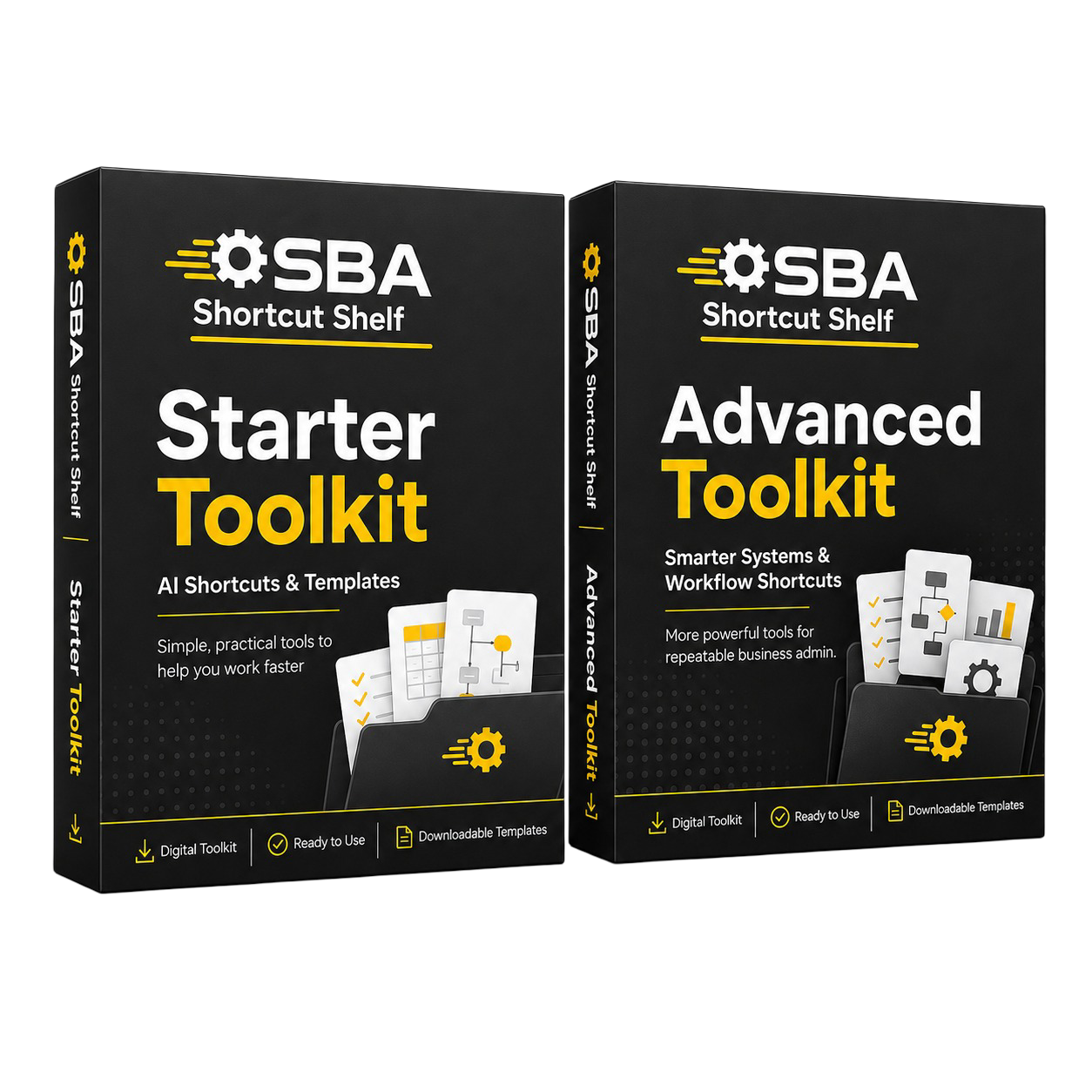
Starter AI Toolkit
The Starter option is the lower-cost, beginner-friendly entry point. It contains 5 practical prompt categories, 25 role-specific prompts and 3 Quick Wins. It focuses on common day-to-day tasks and is designed to be useful as a complete standalone product—not a thin preview that only makes sense after an upgrade.
Advanced AI Toolkit
The Advanced option is for people who want deeper, more repeatable support. It contains 5 advanced workflow categories and 50 advanced prompts, alongside 10 reusable resources, 5 workflow playbooks, 5 SOP-style checklists and 5 power-user prompt frameworks.
The purpose is not merely to provide more prompts. It is to help users move from isolated requests towards repeatable ways of briefing AI, organising work, reviewing outputs and supporting recurring processes.
Bundle Pack
The Bundle is the best-value combined purchase for someone who wants both levels. It includes the finished Starter Toolkit PDF and Advanced Toolkit PDF together. It is not a third toolkit or a separate PDF containing exclusive extra material.
You can see how SBA Shortcut Shelf works for a fuller explanation of the three options and how to choose between them.
This structure is another important difference from a one-size-fits-all prompt file. The content is organised to help a beginner get started quickly while also giving more experienced or process-focused users a route into deeper working methods.
The ethos behind SBA Shortcut Shelf
SBA Shortcut Shelf was built to bridge a very ordinary but important gap: many people have heard that AI can be useful, yet still do not know how to apply it confidently to the work they are responsible for.
The answer is rarely more hype. It is clearer guidance.
The Toolkits are written for practical users who may not consider themselves technical. They aim to make AI feel less like a blank chat box and more like a working assistant that can be briefed carefully for a defined task.
That means helping the user think about:
- the task they want support with;
- the audience and purpose of the output;
- the facts, notes or source material the AI should use;
- the tone, constraints and preferred format;
- the details that require checking afterwards;
- the situations where AI should not make or replace a human decision.
This last point matters. SBA Toolkits may support drafting, rewriting, summarising, planning, checklist creation, admin organisation and review preparation. They do not replace professional judgement, human care, official procedures, legal or financial advice, clinical decisions, HR decisions, safeguarding decisions, compliance sign-off or final approval.
The goal is useful assistance with sensible boundaries—not the suggestion that AI can take responsibility for someone’s work.
You can read more about the thinking behind SBA Shortcut Shelf and why the project focuses on calm, practical and role-aware support.
Finding the right SBA Toolkit for your work
The most useful next step is to begin with your real working week rather than the biggest product claim.
Choose three tasks you regularly need to complete. They might include replying to enquiries, preparing a handover, summarising notes, organising actions, drafting an internal update, planning work, reviewing a process or communicating a delay.
Then ask whether the resource you are considering:
- contains examples close to those tasks;
- helps you provide useful context;
- produces an output format you can realistically use;
- is organised well enough to revisit when time is short;
- reminds you what still needs human review.
If you want broad inspiration across many subjects, a general prompt library may be appropriate. If you want a closer fit to a defined job, browse the growing SBA Shortcut Shelf catalogue. It currently covers more than 50 roles and continues to expand.
If your exact role is not listed, you can request a toolkit for your role. A request may help identify an existing close match or inform a future product, although submission does not guarantee that every requested toolkit will be created.
For questions about choosing a product or understanding what is included, you can also contact SBA Shortcut Shelf.
Purchases are supported by a 30-day money-back guarantee, subject to the published refund policy. That provides a lower-risk way to try a focused toolkit while keeping the policy itself as the source of truth for the applicable terms.