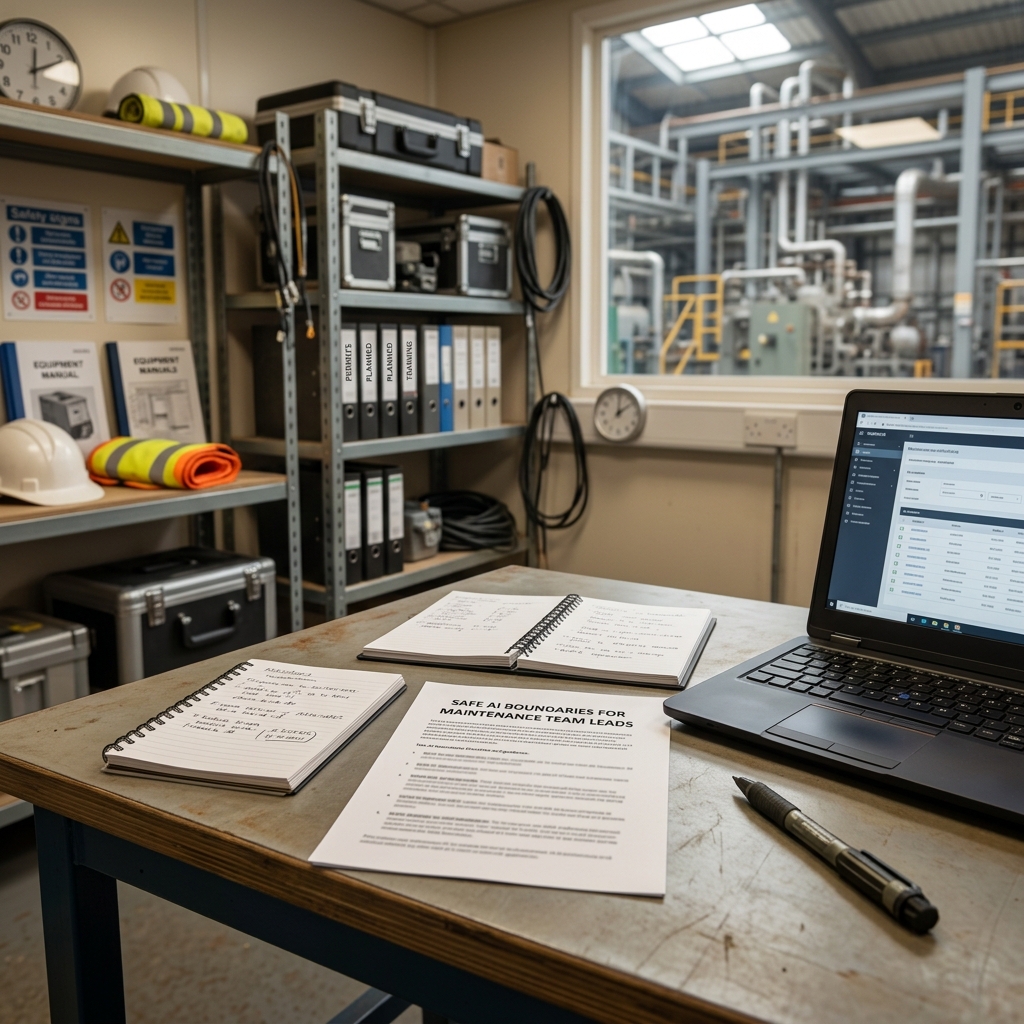
It is the end of shift. You have rough handover notes, a contractor email to tidy, a few SAP or CMMS updates waiting, parts follow-ups still open, and tomorrow’s work to line up before the next team comes in.
AI looks useful in that moment. It can turn messy notes into clearer wording, help structure a follow-up email, or pull a rough list into a more readable format. But in UK hazardous process plant environments, caution is not resistance to technology. It is part of the job.
If you are supervising maintenance in PGM refining, precious metal recycling, chemical processing or similar plant, your admin sits close to permits, isolations, RAMS, contractor control, official records and competent engineering judgement. That means AI needs boundaries before it needs clever prompts.
This guide gives you a practical boundary map for AI safety boundaries for maintenance team leads. It is not legal, engineering, safety or compliance advice. Your company policies, site procedures, approved systems, permit rules, data protection requirements and authorised people always take priority.
Quick answer: AI can be useful for drafting, rewriting and organising non-final maintenance supervisor admin when the information is suitable to share, sensitive details are controlled, and a competent person checks the output.
- Use AI for wording and structure, not for safety-critical decisions.
- Do not ask AI to approve permits, validate RAMS, select isolations, diagnose faults, assess whether work is safe, handle incidents or replace official SAP, CMMS or permit records.
- Treat AI output as a draft only until it has been checked against real notes, approved records and site procedure.
- When in doubt, keep the task in the normal site process and escalate to the authorised person.
If you want ready-to-use prompt structures for drafting and organising maintenance supervisor admin, the Starter AI Toolkit for Maintenance Team Leads in PGM Refining and Process Plant Maintenance (UK) gives you practical wording support for areas such as handovers, follow-up notes, personal checklists and prompt boundaries.
It is designed as a drafting and organisation shortcut only. It does not approve permits, validate RAMS, make engineering decisions, control SAP or CMMS records, replace site procedures or provide safety judgement.
Affiliate disclosure: This article may contain an affiliate link, which means SBA Shortcut Shelf may earn a commission, at no extra cost to you. If you want a simple place for non-sensitive reminders such as planner chasers, stores follow-ups and draft-note reviews, Todoist is one option to consider.
Why maintenance team leads need AI boundaries before prompts
For a maintenance team lead, AI is not just another office tool. The work you are trying to tidy often comes from real plant conditions, live contractor activity, planned maintenance, reactive breakdowns, permit interfaces, handovers and next-day planning pressure.
The issue is not whether AI can produce tidy wording. It usually can. The issue is whether the task is suitable for AI support at all, and whether the output could be mistaken for an authorised instruction, a checked record, or a safe decision.
In PGM refining, precious metal recycling and hazardous process plant maintenance, a few words can matter. A badly worded note can confuse a planner. A vague contractor follow-up can leave an action unclear. A draft CMMS note that adds assumptions can distort maintenance history. A prompt that includes sensitive plant or incident information can create confidentiality and data protection concerns.
AI output can be incomplete, overconfident or wrong. It may fill gaps that should have stayed blank. It may make a rough note sound more certain than it really is. It may produce wording that looks professional but does not match the actual work done.
That is why beginner users need boundaries before prompts. A boundary gives you a simple test before you paste anything into a tool: is this just drafting, is it preparation that needs extra review, is it a human-led decision, or is it something AI should not be asked at all?
The four-zone AI boundary map for maintenance supervisors
A useful way to think about AI in process plant maintenance is to split tasks into four zones. This is a practical decision aid, not an externally validated model or a replacement for site rules.
Zone 1 is safer drafting support. This is where AI helps with wording and organisation for non-final, non-sensitive admin. The supervisor still checks it, but the task is mainly about clarity rather than decision-making.
Zone 2 is extra-review preparation. AI may help prepare a draft or organise questions, but the output touches higher-risk areas such as SAP or CMMS notes, contractor follow-up, RAMS comments, backlog wording or next-day work planning. Nothing from this zone should be entered, sent or relied on without careful checking against approved records and site process.
Zone 3 is human-led decisions. AI may not decide, approve, authorise or accept risk. These matters belong with competent authorised people, approved procedures and the site’s normal control systems.
Zone 4 is never-ask-AI territory. These are prompts you should not use because the information or decision is safety-critical, confidential, incident-related, legally sensitive, commercially sensitive or controlled by site procedure.
Before using any maintenance supervisor AI prompts, pause and classify the task. If it is not clearly Zone 1, assume it needs stronger review or should stay entirely out of the AI tool.
Zone 1: Safer drafting support for non-final supervisor admin
Zone 1 is the sensible starting point for beginner AI users. These are tasks where the tool helps you express information more clearly, without adding technical content, making decisions or creating official records.
Examples include turning rough shift debrief bullets into clearer handover wording, rewriting a non-sensitive email to a planner, formatting a list of follow-up actions, creating an agenda for a maintenance coordination call, improving the tone of a training reminder, or preparing neutral questions to take to an authorised engineer or planner.
The key word is draft. The AI output should not become the final version until you have checked it against your actual notes. It should not add causes, conditions, asset details, instructions, dates, permit comments or work status that you did not provide.
Use data minimisation as your default. Remove names, personal data, asset identifiers, batch or process details, incident information, contractor commercial details and any site-sensitive content unless your employer has approved that AI tool for that type of information.
A safer Zone 1 prompt sounds like this:
Turn these anonymised shift debrief bullets into a clear draft handover note. Do not add technical facts, causes, instructions or assumptions. Keep any uncertain points as questions for human review.
This is still only suitable for anonymised, non-final drafting. You must check the wording against real shift facts and use the approved handover or site process.
Zone 2: Extra-review tasks around CMMS, SAP, RAMS preparation and contractor follow-up
Zone 2 is where AI can look useful but the risk rises. The task may still be about wording, but the output sits close to official records, contractor controls, maintenance history or safety documentation.
AI may support a draft CMMS or SAP note from accurate supervisor notes. It may help tidy backlog clean-up wording, structure planned work summaries, rewrite a contractor follow-up email, organise RAMS questions, format a parts chase list, or pull next-day planning notes into a clearer sequence.
However, preparation is not approval. AI must not invent work done, close jobs, diagnose causes, alter official facts, decide whether a contractor document is acceptable, interpret permit requirements, approve RAMS or decide whether work can proceed.
For example, a draft contractor email can ask for missing information in clearer language. It cannot approve the RAMS, judge whether the method is safe, or give technical instructions. A draft SAP or CMMS note can tidy wording from your real notes. It cannot create a maintenance history for work it cannot verify.
A cautious Zone 2 prompt might be:
Rewrite this non-sensitive contractor follow-up email so it is clear and professional. Ask for the missing information, but do not approve the RAMS, judge whether the work is safe or give technical instructions.
Before anything from Zone 2 is sent, entered or relied upon, check it against the actual work, approved records, site procedures and the relevant authorised person. If the output changes the meaning, adds certainty or implies approval, do not use it.
Zones 3 and 4: Human-led decisions and never-ask-AI tasks
Zones 3 and 4 are where the boundary needs to be firm. AI should not be treated as a permit controller, engineer, RAMS assessor, incident adviser, SAP owner, CMMS authority or substitute for site procedure.
Human-led decisions include permit acceptance or approval, isolation decisions, breaking containment decisions, confined space decisions, hot work decisions, return-to-service decisions, plant fault diagnosis, safety risk acceptance, maintenance deferral decisions, incident response, compliance interpretation and engineering judgement.
AI may help you prepare neutral questions for the right person, but it should not answer the safety-critical question for you. For example, it is reasonable to ask for a clearer list of questions to take to an authorised engineer. It is not reasonable to ask AI whether the job is safe to proceed.
Never-ask-AI tasks include uploading confidential plant data to an unsanctioned tool, asking AI to approve RAMS, asking AI to decide an isolation scheme, asking AI whether a permit should be accepted, asking AI to rewrite incident facts to make them sound better, or asking AI to generate official records for work it cannot verify.
Incident-related information needs particular care. Do not use AI to soften, reshape or improve the appearance of facts. If wording support is ever allowed under your company process, it should not change facts, sequence, responsibility, uncertainty or evidence. Follow the approved incident and reporting process.
The safest framing is simple: AI can help with wording around the edges of supervisor admin. It must not make or influence safety-critical decisions that belong with competent authorised people, approved records and site procedures.
How to use AI safely in the supervisor routine
A practical routine is better than relying on memory at the end of a busy shift. Use the same short check before any AI-assisted maintenance admin.
- Classify the task. Is it drafting, preparation, a decision, or prohibited? If it touches authorisation, safety risk, permits, isolations, incidents or official records, slow down.
- Remove sensitive information. Do not include names, personal data, confidential plant details, asset identifiers, process conditions, incident details or contractor commercial information unless the tool is approved for that data.
- Ask for drafting only. Tell AI not to add facts, causes, instructions, assumptions, approvals or technical judgement.
- Review against real notes. Check the output against what actually happened, what was observed, and what is recorded in approved systems.
- Use approved systems for official records. AI text is not an official record until it has been checked, corrected and entered through the approved process by an authorised person.
- Escalate the right questions. Safety, engineering, permit, RAMS, return-to-service and compliance questions should go to the authorised people and normal site process.
For personal organisation only, you can ask AI to create a follow-up checklist from anonymised admin notes. Keep it separate from permit control, SAP, CMMS, incident management and safety-critical coordination.
Create a personal follow-up checklist from these anonymised admin notes. Separate items for planner, stores, contractor, engineer review and supervisor check. Do not create permit actions or safety instructions.
If you use a personal task app, keep the same boundary. Todoist can be a useful option for non-sensitive reminders such as chasing a planner response, checking whether a stores query has been answered, or reminding yourself to review a draft note. It should not be used as a permit system, RAMS tracker, CMMS replacement, SAP substitute, isolation control tool or incident management tool. You can find Todoist here: Todoist.
Whatever tool you use, company policies, site procedures, approved systems and human authorisation override any AI-assisted draft.
A four-zone AI safety boundary map for maintenance team leads
Use this quick map before you put maintenance information into an AI tool. If a task falls between two zones, treat it as the higher-risk zone.
Zone 1: Safer drafting support
- Use AI for: handover wording, non-sensitive emails, action list formatting, meeting agendas, training reminders and clearer bullet points.
- Keep control by: anonymising notes, removing sensitive details, asking for wording only and checking every line before use.
- Boundary: AI must not add technical facts, infer missing conditions, create instructions or make the wording sound more certain than your notes support.
Zone 2: Extra-review preparation
- Use AI cautiously for: draft CMMS or SAP note wording, backlog clean-up notes, contractor follow-up wording, RAMS question preparation, parts chase lists and next-day work planning notes.
- Keep control by: checking against actual work, approved records, site process and authorised people before anything is entered, sent or relied upon.
- Boundary: AI must not invent work done, close jobs, interpret permit requirements, approve RAMS or decide whether contractor documentation is acceptable.
Zone 3: Human-led decisions
- Keep with authorised people: permit acceptance or approval, isolation decisions, breaking containment, confined space decisions, hot work decisions, return to service, fault diagnosis, risk acceptance, maintenance deferral, incident response, compliance interpretation and engineering judgement.
- AI role: at most, prepare neutral questions or tidy non-final wording for a competent person to review.
- Boundary: AI may not decide, approve, authorise or accept risk.
Zone 4: Never-ask-AI tasks
- Do not use AI to: approve RAMS, decide if work is safe, select an isolation scheme, rewrite incident facts to sound better, upload confidential plant data to an unapproved tool, or generate official records for work it cannot verify.
- Keep control by: following site procedure, using approved systems and escalating to the correct authorised person.
- Boundary: if the prompt asks AI to replace a competent person, an approved system or an official process, do not use it.